
Gal Vihara
Gal Vihara is widely regarded as the most perfect specimen of rock carving in Sri Lanka and is the crowning artistic achievement of the ancient city of Polonnaruwa, a UNESCO World Heritage Site.
Historical Significance
- Builder and Era: The temple, originally known as Uttararama (Northern Monastery), was commissioned by the powerful King Parakramabahu I (1153–1186 CE) during the Polonnaruwa Kingdom’s golden age.
- Religious Reform: Beyond its artistic importance, the site is historically critical. It was here that King Parakramabahu I convened a great assembly of monks to unify the fragmented Buddhist orders (Nikayas) of the country and cleanse the clergy.
- The Inscription: The resulting code of conduct (Katikavata) for the unified Buddhist monastic order was permanently inscribed on the rock face at Gal Vihara, making the site a central record of Theravada Buddhist reform.
The Four Masterpiece Sculptures
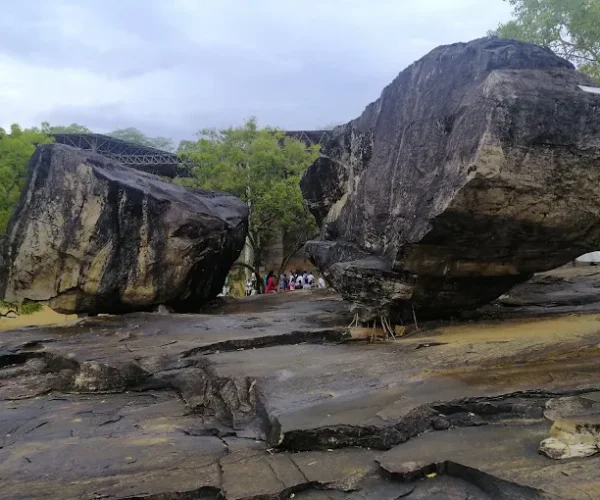
All four colossal statues are carved out of a single, massive granite outcrop, showcasing the incredible skill of 12th-century Sinhalese craftsmen.
Key Detail: Look closely at the feet—they are subtly offset rather than perfectly parallel, which is the canonical sign distinguishing the passing into Nirvana from a simple resting posture. The carved pillow under the head is also sculpted to show a slight, natural-looking depression.
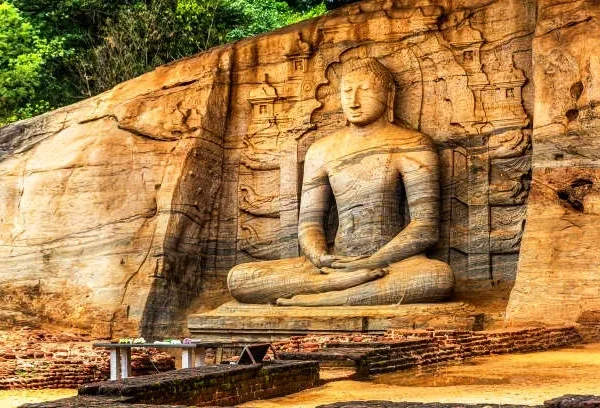
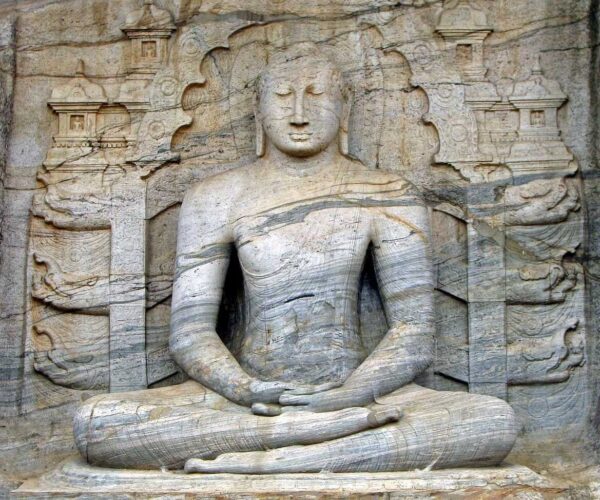
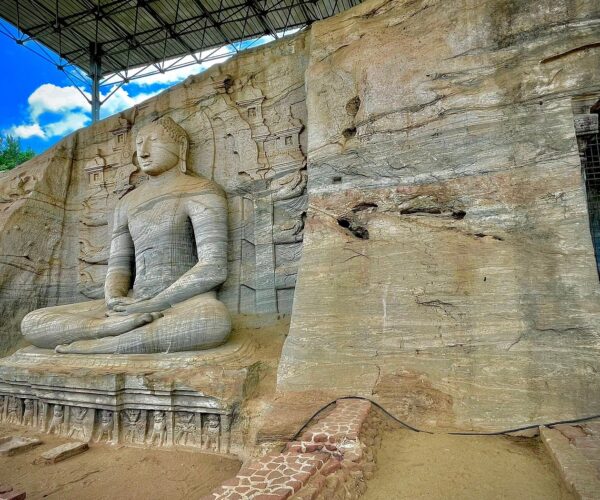
- The Large Seated Buddha (Vajrasana):
Posture: The Dhyana Mudra (meditation pose), representing the moment of Enlightenment.
Detail: It sits on a lotus throne, with a detailed arch and miniature Buddha images carved into the rock face behind it, often cited as evidence of Mahayana Buddhist influence at the time.
2. The Smaller Seated Buddha (Vidyadhara Guha):
Setting: Located inside a partially carved artificial cave (Guha).
Detail: This smaller statue in a meditation posture is flanked by relief carvings of Hindu deities, Brahma and Vishnu, reflecting the cultural fusion of the era.
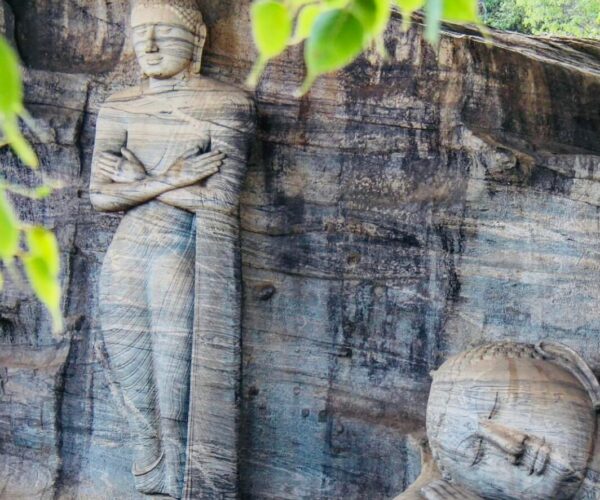
3. The Standing Figure (Contemplative or Ananda?):
The Controversy: This is the most debated statue. Its height (approx. 23 feet) and unusual posture—arms crossed over the chest with a seemingly sorrowful expression—led some scholars to argue it depicts Ananda, the Buddha’s chief disciple, grieving over the Master’s imminent passing (Parinirvana).
Modern Consensus: However, based on the presence of a lotus pedestal and other iconographic details reserved for the Buddha, most scholars now agree it is the Buddha himself, possibly depicting the Para Dukka Dukkhitha Mudra (a gesture of sorrow for the suffering of humanity) or a pose of deep contemplation.
4. The Reclining Buddha (Parinirvana):
Length: A massive figure, approximately 46 feet (14 meters) long.
Significance: It represents the Buddha’s peaceful entry into Parinirvana (final passing and liberation from the cycle of rebirth).
Key Detail: Look closely at the feet—they are subtly offset rather than perfectly parallel, which is the canonical sign distinguishing the passing into Nirvana from a simple resting posture. The carved pillow under the head is also sculpted to show a slight, natural-looking depression.
Why go?
Gal Vihara is widely regarded as the most perfect specimen of rock carving in Sri Lanka and is the crowning artistic achievement of the ancient city of Polonnaruwa, a UNESCO World Heritage Site.
Tour Highlights
- Holiday with friends & family.
- As many activities & excursions as can be fitted in to your trip.
- Go any day of the week and most times of the year.